 By Hodaka Hashi
When you play a note on a guitar, and in fact almost all instruments, you’re not playing one note, but a whole family of notes at the same time – called harmonics. It’s the brain that makes it sound like one note. The particular harmonics that are present in this family and their individual intensities is what gives rise to the different characteristics of different sounds generated by different instruments.
For example when an open E is played on a guitar, there are many harmonics that are present as discussed before in the guitar pickups lesson. This is shown below just as a reminder:
Harmonic Content of an Open E String
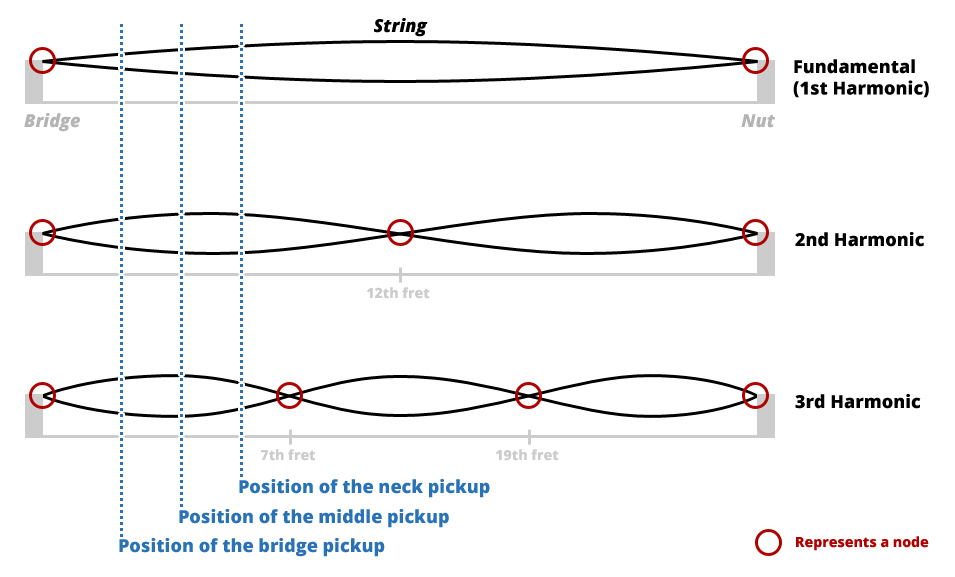
This shows the first three harmonics of an open E string – there are in fact many more harmonics within the harmonic spectrum of an open E string. The note being played, i.e. the E in this case, is referred to as the fundamental (and less commonly the 1st harmonic). The others are called the 2nd harmonic, the 3rd harmonic and so on.
When you play what is referred as a harmonic on a guitar, you’re in fact playing an artificial harmonic by forcing one of these harmonics to sound without the fundamental.
Note in the diagram above, there are points on the string called ‘nodes’. These are points on the string that do not vibrate. So excluding the nut and bridge the second harmonic has 1, the third harmonic has 2, the fourth harmonic will have 3 and so on… A harmonic is achieved by forcing one of these points to be a node. For example if you want to play the 3rd harmonic, the string above the 7th or 19th fret must somehow be forced to be a node.
This can be achieved in the following ways.
Natural Harmonics
This is also known as an ‘Open String Harmonic’.
Natural harmonics are achieved by gently touching your finger against certain positions on the string without letting the string touch the fret and picking the string with the right hand using a plectrum. When playing harmonics the best result is achieved by picking the string close to the bridge, and also selecting the bridge pickup using the selector switch (see Tone, Volume and Selector Switch).
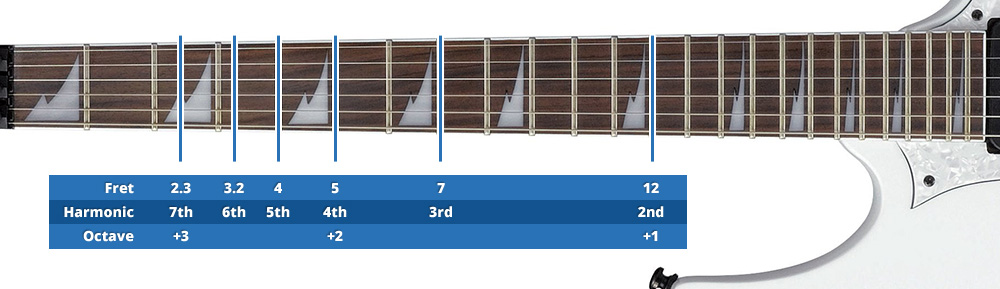
This diagram shows the positions that you should touch your finger to get certain harmonics. For example, to get the 5th harmonic on the D string you must gently touch the 5th fret with your finger and then pick the D string hard, near the bridge. This will give a D that is 2 octaves above the open D string.
Artificial Harmonics
The artificial harmonic allows a harmonic to be played on a fretted note. It’s achieved by pressing a particular fret, for example the 2nd fret of the D string, and then lightly touching the same string 12 frets up. You then need to pick the strings with either your other fingers or using a pick held between the other fingers on your right hand.
This is shown below:

Pinched Harmonics
This is a difficult technique to master and will take you some time before you can play it on demand. Like the artificial harmonic it allows a harmonic to be played on a fretted note.
When carrying out this technique what you’re trying to achieve is to pick the string as usual with the plectrum, but then hit the strings with your thumb almost simultaneously. For this the plectrum is usually held so that only a small proportion of it is sticking out from beneath your finger and thumb. The string is fretted, the plectrum is used to pick the note and then the thumb hits the string soon after.
Please note that the thumb only momentarily makes contact with the strings. Also it’s vital to note that the position where you pick the strings matters. There are locations along the string often referred to as ‘sweet spots’ and the string must be picked here. If you fail to do so the harmonic will not sound. Experience is the key here, so practice until you’re comfortable with pinched harmonics.
Tapped Harmonics
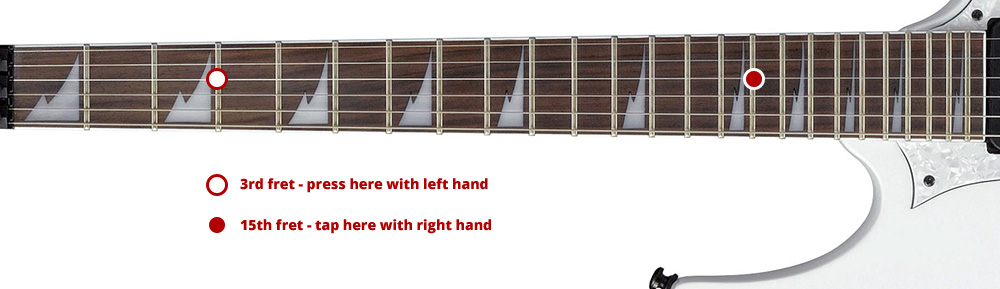
A tapped harmonic refers to a harmonic that is sounded when you press on a specific fret with your left hand and then tap the string 12 frets above it with your right hand. For example if you want to play a tapped harmonic on the 3rd fret of the G string, you would press on the 3rd fret with your left hand and tap the string on the 15th fret with your right hand using your index or middle finger.
To further clarify this concept, examine the diagram below:
Guitar Tab Notation
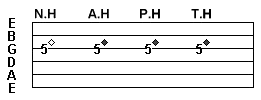
This shows the four different notations that can be used in guitar tab. The natural harmonic, i.e. the open string harmonic, can be denoted with the hollow diamond next to the note or N.H above the tab. The artificial harmonic on the other hand uses a solid diamond or A.H above the tab. The pinched and tapped harmonics are denoted in a similar fashion but with a P.H and T.H respectively.
- Want to improve your guitar playing?
-

These lessons have been written by me, a guitar enthuthiast. I've written them to the best of my abilities, but I'm no guitar teacher!
If you want award-winning, well structured but inexpensive lessons, I strongly recommend you check out Guitar Tricks. They have great range of video guitar lessons from numerous coaches specialising in a wide range of styles.
I've seen their videos, and they're great. With these guys, I'm confident you'll be improving in no time!