 By Hodaka Hashi
Playing bar chords is always a tricky thing for guitar players to pick up. The main purpose of this lesson is to help beginners to understand this technique a little better. I have decided to write this lesson in 2 parts as there is a lot of information to take in. I would like you to take your time with this and make sure you get it down. This is a very important technique that will give you freedom to play chords in any position on the fretboard.
Beginner’s introduction to bar chords
For anyone who is new to guitar playing then hopefully I can explain to you what a bar chord is. I am assuming you already have basic knowledge of ‘open chords’ already; that basically means chords played in the lower part of the neck that use open strings. If you aren’t familiar with open chords then please learn these first.
A bar chord simply means any chord where you have to play more than one note using the same finger on the left hand. This is done by laying your finger flat across the strings you want to play. I will be dealing with chords that use the first finger as a bar.
The great thing about bar chords is you can play chords anywhere on the neck. To illustrate this, I’d like you to follow these steps:
- To start off, play an E major chord in open position. Most people will play this chord using the first 3 fingers, but not use the pinky.
- Now we will try fingering this chord differently. Place your 3rd finger on the 2nd fret of the A string.
- Place your 4th finger on the 2nd fret of the D string.
- Place your 2nd finger on the first fret of the G string. You should now be playing the same E major chord, although your first finger is no longer being used.
- Take this finger pattern and move it 3 frets up the neck; your 3rd finger should now be on the 5th fret.
- While keeping your fingers in this position, lay your first finger flat across all strings at the 3rd fret.
You should end up with a chord that looks like this on the fretboard, starting on the 3rd fret:
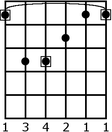
E Major shape
You are actually now playing a G major chord using the E major shape! You have simply taken the basic E major open position chord and moved it up 3 frets. Compare this with the G major open position chord and you’ll notice they both sound the same. You should try and apply this method to all of your open position shapes so that you can play them anywhere on the fretboard.
Moving around the shapes
With all the basic open position chords, the lowest note in the chord (on the string closest to the roof) is always the root note. For example if I played an A major chord in the open position then the lowest note in the chord would be an A. This means that you can move around the same shape to play different chords as long as you know the root note of your chord shape. For example the 8th fret on the low E string is a C note, therefore if you play the E major open chord shape with the bar across the 8th fret then you will be playing a C major chord. Again check that this sounds like the C major open chord you should be familiar with.
I must emphasise that, when you are fingering any bar chord shape, you place all of your other fingers in position BEFORE you place down the bar with your first finger. There are so many lessons on the internet that tell you to place the bar down first, however I believe this is poor advice and will make things more difficult. Try it for yourself and I’m sure you will agree.
I shall leave you with a few of the basic bar chords to try out. You should recognise these because they all look like the basic open position chords. Remember you can move these shapes around anywhere you like. In part 2 I will teach you some of my secrets in how to play bar chords completely effortlessly. Enjoy!
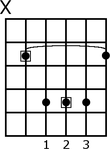
A Major shape
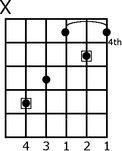
C Major shape
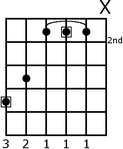
G Major shape
- Want to improve your guitar playing?
-
These lessons have been written by me, a guitar enthuthiast. I've written them to the best of my abilities, but I'm no guitar teacher!
If you want award-winning, well structured but inexpensive lessons, I strongly recommend you check out Guitar Tricks. They have great range of video guitar lessons from numerous coaches specialising in a wide range of styles.
I've seen their videos, and they're great. With these guys, I'm confident you'll be improving in no time!