 By Hodaka Hashi
Triads refer to chords that are comprised of 3 separate notes; the root note, a third and a fifth (with respect to the root note). The exact interval of the third and the fifth depends on the type of triad in question. There are 4 types of triads which are the major, minor, diminished and augmented chords.
Major Triad
Listen to a C major triad:
The major triad consists of a major third, and a perfect fifth interval. This is symbolized in terms of semitones as 0-4-7. As an example, let us build a C major triad:
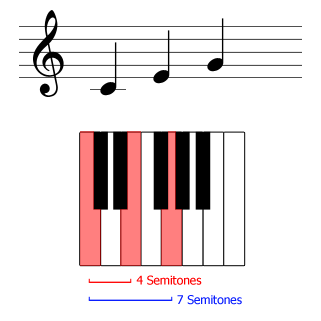
The C major triad
Here, the C is the root note. Then we take notes that are 4 and 7 semitones above the root note to form the C major triad.
Minor Triad
Listen to a C minor triad:
The minor triad on the other hand is made up of a minor third and a perfect fifth, which is represented as 0-3-7 in terms of semitones. The C minor triad is shown below to clarify the concept of minor triads:
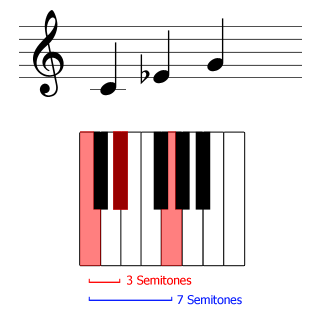
The C minor triad
Diminished Triad
Listen to a C diminished triad:
The diminished triad is comprised of a minor third and a diminished fifth, and is represented as 0-3-6. The C diminished triad is shown below:
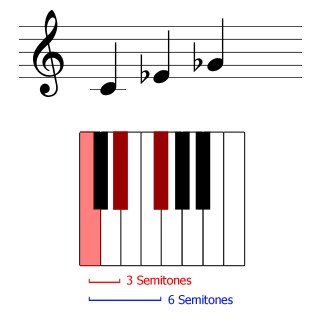
The C diminished triad
Augmented Triad
Listen to a C augmented triad:
The augmented triad contains a major third and an augmented fifth, which is 0-4-8 in terms of semitones. A C augmented triad is shown below:
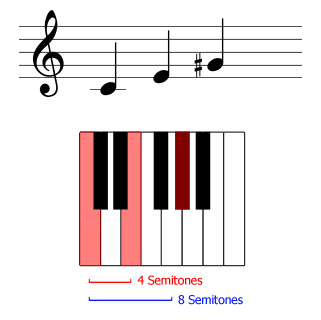
The C augmented triad
- Want to improve your guitar playing?
-

These lessons have been written by me, a guitar enthuthiast. I've written them to the best of my abilities, but I'm no guitar teacher!
If you want award-winning, well structured but inexpensive lessons, I strongly recommend you check out Guitar Tricks. They have great range of video guitar lessons from numerous coaches specialising in a wide range of styles.
I've seen their videos, and they're great. With these guys, I'm confident you'll be improving in no time!