 By Hodaka Hashi
In music theory, understanding steps, tones, and accidentals is crucial for grasping how different notes relate to each other and how they can be altered to create various musical effects. This guide will help you navigate these fundamental concepts, making it easier to understand and apply them in your playing and reading of music.
Steps and Tones: Navigating Musical Intervals
Steps refer to the specific distance or interval between two notes. These intervals are crucial in determining the relationship between notes in a scale, chord, or melody. To better understand this, let’s use a piano keyboard as a visual reference.
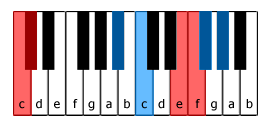
On a piano, the distance between two closest adjacent notes (whether they’re white or black keys) is called a half step. For example, the distance between the note C and the black key immediately to its right (C♯/D♭) is a half step. Another half step example is between E and F, which are also adjacent notes with no black key in between. These examples are shown in red in the image above.
A whole step, on the other hand, is equivalent to two half steps. This means there is one key between the two notes on the keyboard. For example, the distance between A♯/B♭ and C is a whole step, as is the distance between F♯/G♭ and G♯/A♭. These examples are shown in blue in the image above.
Whole steps and half steps are the building blocks of scales and melodies in music.
Tones and Semitones: A Different Terminology for the Same Concept
In many musical contexts, especially in European classical music theory, the terms tones and semitones are used instead of steps:
- A semitone is the equivalent of a half step, representing the smallest interval used in Western music.
- A tone is the equivalent of a whole step, comprising two semitones.
This terminology is interchangeable with steps and is commonly used in discussions of scales and intervals.
Accidentals: Altering the Pitch of Notes
Accidentals are symbols used in music notation to alter the pitch of a note. They can raise or lower the pitch by a half step or a whole step, allowing for a greater range of expression and variation in music. There are four main types of accidentals, along with the natural symbol, which cancels a previous accidental.
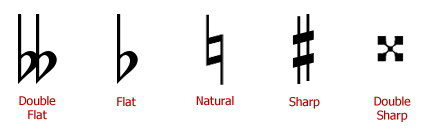
Flat (♭)
A flat lowers the pitch of a note by a half step (semitone). For example, if you see a G with a flat (G♭), you would play the note that is a half step lower than G, which is the black key immediately to the left of G on a keyboard. G♭ is enharmonically equivalent to F♯, meaning they sound the same but are written differently depending on the musical context.
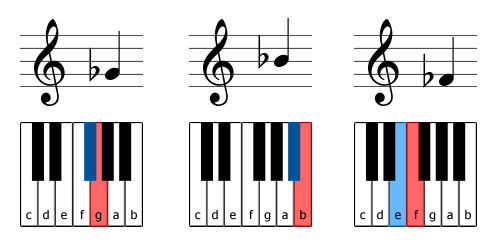
It’s important to note that not all flat notes correspond to black keys. For instance, F♭ corresponds to the note E because there is no black key between them on the keyboard.
Sharp (♯)
A sharp raises the pitch of a note by a half step. For example, G♯ would be played by moving up one key from G to the black key immediately to the right of G. G♯ is enharmonically equivalent to A♭.
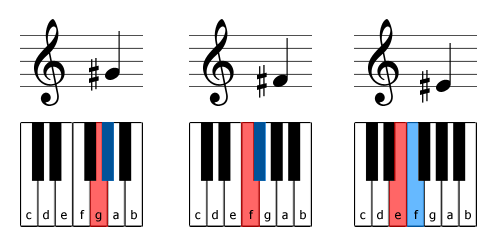
In written music, sharp notes are indicated by placing a ♯ symbol before the note. For example, G sharp can be written as G♯.
Double Flats (♭♭) and Double Sharps (𝄪)
Double flats and double sharps alter the pitch by a whole step (two semitones). A double flat lowers the note by two half steps, while a double sharp raises the note by two half steps. For example:
- G♭♭ (double flat) is the same as F.
- G𝄪 (double sharp) is the same as A.
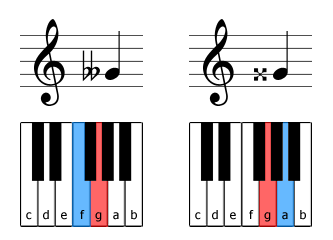
Double flats and double sharps are less common but are used in certain musical contexts to maintain the correct spelling of a scale or chord, especially in more complex pieces.
Natural (♮)
The natural symbol is used to cancel a previous accidental and restore the note to its original pitch. For instance, if a G has been sharped to G♯, placing a natural sign (♮) before the G would return it to its natural state, G.
Enharmonic Spelling: Multiple Names for the Same Pitch
In music, certain notes can be referred to by different names depending on the context. This phenomenon is known as enharmonic spelling. For example:
- G♯ and A♭ are enharmonic equivalents—they are the same pitch but are written differently.
- F♯ and G♭ are also enharmonic equivalents.
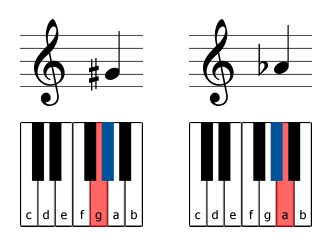
The choice of enharmonic spelling often depends on the key of the music or the theoretical context. For example, in a key that is based on sharps (like G major), you would use G♯ rather than A♭.
Putting It All Together: Applying Steps, Tones, and Accidentals
Understanding steps, tones, and accidentals is essential for reading music, understanding scales, and navigating the keyboard or fretboard. Here’s a quick summary of the key points:
- Steps and tones refer to the intervals between notes: half steps (semitones) and whole steps (tones).
- Accidentals (flats, sharps, double flats, double sharps, and naturals) alter the pitch of notes by a half step or a whole step.
- Enharmonic spelling allows for different notations of the same pitch, which is important for maintaining the integrity of musical scales and keys.
By mastering these concepts, you’ll have a solid foundation in music theory that will help you read, write, and play music more effectively.
- Want to improve your guitar playing?
-

These lessons have been written by me, a guitar enthuthiast. I've written them to the best of my abilities, but I'm no guitar teacher!
If you want award-winning, well structured but inexpensive lessons, I strongly recommend you check out Guitar Tricks. They have great range of video guitar lessons from numerous coaches specialising in a wide range of styles.
I've seen their videos, and they're great. With these guys, I'm confident you'll be improving in no time!