 By Hodaka Hashi
In music theory, scale degrees refer to the specific notes within a scale, each with its own name and function in relation to the tonic (the first note of the scale). Understanding scale degrees is essential for grasping how scales are constructed and how different notes interact within a key.
The Tonic: The Anchor of the Scale
At the heart of every scale is the tonic—the first note of the scale and the note that all other notes are measured against. The tonic is often called the “home” note because it provides a sense of resolution and stability within the music. Whether you’re playing a major, minor, or any other type of scale, the tonic sets the foundation for the scale’s structure.
For example, in a C major scale, the tonic is C. All other notes in the scale are defined by their distance (or interval) from this tonic note.
The Seven Scale Degrees
In any diatonic scale (such as a major or minor scale), there are seven distinct scale degrees, each with its own name. These names are derived from their relationship to the tonic and their role within the scale. Below are the seven scale degrees, listed in order from the tonic to the seventh degree:
- Tonic (1st Degree): The first and most important note in the scale. All other scale degrees are measured in relation to the tonic.
- Supertonic (2nd Degree): The note one step above the tonic. It often acts as a lead-in to more stable notes like the mediant or dominant.
- Mediant (3rd Degree): Positioned midway between the tonic and dominant, the mediant defines whether the scale is major or minor.
- Subdominant (4th Degree): The note one step below the dominant and often used to create tension before resolving back to the tonic or dominant.
- Dominant (5th Degree): One of the most important notes after the tonic, the dominant is five steps above the tonic and creates strong harmonic movement when resolving back to the tonic.
- Submediant (6th Degree): Situated between the subdominant and the leading tone or subtonic, the submediant plays a role in modulating to different keys and creating contrast.
- Leading Tone/Subtonic (7th Degree): The seventh scale degree has two different names depending on its interval with the tonic in the next octave:
- Leading Tone: If the seventh note is a semitone below the tonic of the next octave, it is called the leading tone. It creates a strong pull back to the tonic, giving the scale a sense of tension and resolution.
- Subtonic: If the seventh note is a whole tone (whole step) below the tonic of the next octave, it is called the subtonic. This creates a weaker pull back to the tonic and is often found in minor scales.
Visualizing the Scale Degrees
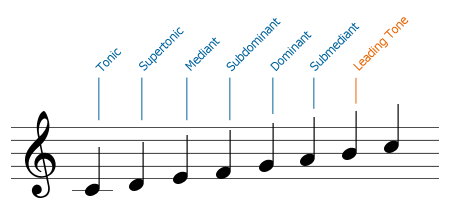
To illustrate, let’s examine the C major scale: C – D – E – F – G – A – B – C. In this scale:
- The first note (C) is the tonic.
- The second note (D) is the supertonic.
- The third note (E) is the mediant.
- The fourth note (F) is the subdominant.
- The fifth note (G) is the dominant.
- The sixth note (A) is the submediant.
- The seventh note (B) is the leading tone because it is a semitone below the next C (the tonic of the next octave).
In major scales, the seventh note is always a leading tone because it is a semitone away from the tonic.
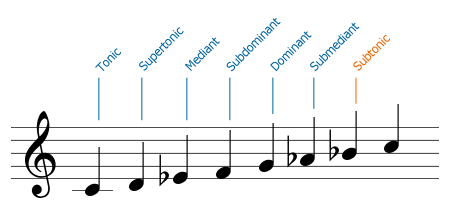
Now, consider the C natural minor scale: C – D – E♭ – F – G – A♭ – B♭ – C. In this scale:
- The seventh note (B♭) is a whole tone away from the tonic C in the next octave, which makes it a subtonic rather than a leading tone.
In natural minor scales, the seventh note is typically a subtonic because it is a whole tone below the tonic of the next octave.
Harmonic and Melodic Minor Scales: Leading Tone or Subtonic?
The distinction between the leading tone and the subtonic becomes even more interesting when we examine other types of minor scales, particularly the harmonic minor and melodic minor scales.
- Harmonic Minor Scale:
The harmonic minor scale raises the seventh degree by a semitone compared to the natural minor scale. For example, in the C harmonic minor scale (C – D – E♭ – F – G – A♭ – B – C), the seventh note (B) is now a semitone away from the tonic C in the next octave, making it a leading tone. This alteration creates a stronger pull towards the tonic and gives the harmonic minor scale its characteristic tension. - Melodic Minor Scale:
The melodic minor scale has different ascending and descending forms. When ascending, the sixth and seventh degrees are raised by a semitone, creating a leading tone. For example, in the C melodic minor scale ascending (C – D – E♭ – F – G – A – B – C), the seventh note (B) is a leading tone. However, when descending, the scale reverts to the natural minor form, with the seventh note becoming a subtonic (B♭ in this case).
Exercise: Identifying the 7th Degree
To solidify your understanding, try identifying whether the seventh degree is a leading tone or subtonic in different scales:
- In the G major scale (G – A – B – C – D – E – F♯ – G), is the seventh degree a leading tone or subtonic?
- In the A natural minor scale (A – B – C – D – E – F – G – A), is the seventh degree a leading tone or subtonic?
Remember, the determining factor is the interval between the seventh note and the tonic of the next octave. If it’s a semitone, it’s a leading tone; if it’s a whole tone, it’s a subtonic.
Conclusion: The Importance of Scale Degrees
Understanding scale degrees helps you grasp the structure and function of notes within a scale. The tonic is the anchor point, and every other note in the scale plays a unique role in creating harmony and melodic movement. Whether you’re dealing with a major scale, natural minor scale, or harmonic minor scale, recognizing the relationships between these scale degrees is essential for effective music composition and analysis.
By mastering the concept of scale degrees, you gain greater control over your playing and can better understand how different notes function within the music.
- Want to improve your guitar playing?
-

These lessons have been written by me, a guitar enthuthiast. I've written them to the best of my abilities, but I'm no guitar teacher!
If you want award-winning, well structured but inexpensive lessons, I strongly recommend you check out Guitar Tricks. They have great range of video guitar lessons from numerous coaches specialising in a wide range of styles.
I've seen their videos, and they're great. With these guys, I'm confident you'll be improving in no time!