 By Hodaka Hashi
A major scale is comprised of 7 individual notes and has the interval pattern, TTSTTTS, where T represents a tone, and S a semitone. If you’re not sure what these are, read our previous lesson on steps, tones & accidentals.
The C major scale is the simplest major scale on a piano, as it is comprised of the white keys. We’ll therefore use the C major scale to clarify the concept of the major scale.
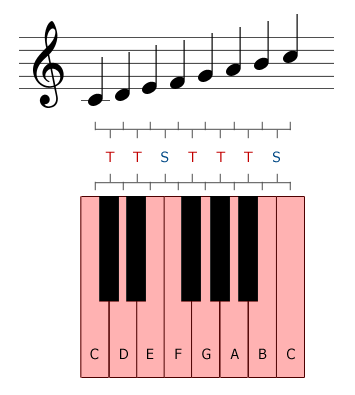
The C major scale
The above image shows a C major scale. This scale starts and finishes on a C, and therefore the C is called the base note. The next note is a tone above the base note, i.e. a whole step above, which in this case is a D. The note above the D is a tone above it again, and is therefore an E. Then an F as it is a semitone above E. It follows the TTSTTTS pattern as discuss above until the scale is complete.
As all major scales have the same interval pattern, it’s easy to compile other major scales. For example we could compile the E major scale as shown below:
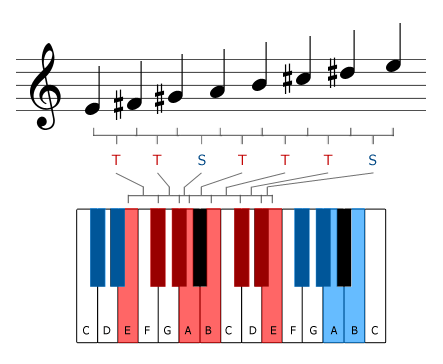
The E major scale
For the E major scale we would start from the E, i.e. the base note, and follow the same interval pattern as before. The red keys above show 1 octave of the E major scale, and the blue keys represent notes in other octaves.
- Want to improve your guitar playing?
-

These lessons have been written by me, a guitar enthuthiast. I've written them to the best of my abilities, but I'm no guitar teacher!
If you want award-winning, well structured but inexpensive lessons, I strongly recommend you check out Guitar Tricks. They have great range of video guitar lessons from numerous coaches specialising in a wide range of styles.
I've seen their videos, and they're great. With these guys, I'm confident you'll be improving in no time!