 By Hodaka Hashi
There are often times when certain accidentals are used repeatedly throughout music. As it’d be very inefficient and cluttered if the accidentals where placed next to each and every note, they’re collected and placed at the beginning of the music and these are called key signatures.
Key signatures are written in a certain order, and this order depends on whether they are sharps or flats.
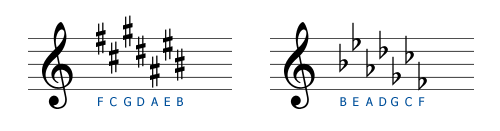
The order of key signatures
The image above illustrates the order that key signatures are written. The key signature for sharp notes has the order, FCGDAEB, whereas the key signature for flat notes has the reverse order, i.e. BEADGCF. The key signatures represent accidentals for the music as a whole, therefore there are shown in this order irrespective of the order they appear on the music.
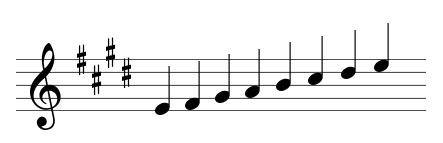
Key signatures – sharps
This image shows the E major scale. If you compare it with the E major scale from the lesson on major scales, you will notice that the sharps have all been collected and placed at the beginning of the staff. From this key signature we can instantly tell that the F, C, G and D are sharps for this scale. We have kept with the conventional order as shown in the first image. Although the order that the sharps appear in is FGCD, we have written the key signature in the order of FCGD. As I say, the order of key signatures aren’t determined by the order they appear on the music.
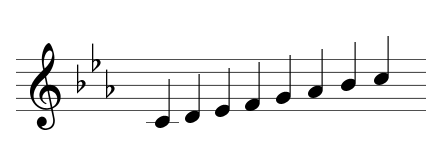
Key signatures – flats
Here’s an example of a C natural minor scale. Make sure you study and understand how the flats have been collected and placed within the key signature.
- Want to improve your guitar playing?
-

These lessons have been written by me, a guitar enthuthiast. I've written them to the best of my abilities, but I'm no guitar teacher!
If you want award-winning, well structured but inexpensive lessons, I strongly recommend you check out Guitar Tricks. They have great range of video guitar lessons from numerous coaches specialising in a wide range of styles.
I've seen their videos, and they're great. With these guys, I'm confident you'll be improving in no time!